Running posture and arm swing: run tall and relaxed

Tria
Your AI running coach
Correct running posture means running tall, with head, shoulders and hips in one line and a slight forward lean that comes from the ankles, not the waist. Your arm swing supports it: elbows bent at roughly a right angle, hands swinging forward and back past your hips rather than across your chest, shoulders low and hands relaxed. Both matter most when you get tired, because that is when posture sags and tension creeps in.
1. Run tall
Imagine a string pulling the top of your head up. Head, shoulders and hips stack in one line, and your chest stays open. This is not standing stiffly to attention: it should feel long and light, not rigid.
Two patterns are common. Sitting back, where the hips stay behind you and you look as if you were about to sit on a chair. And folding forward at the waist, often when running uphill or late in a run. Both make it harder to land under your body.
2. Lean from the ankles, not the waist
A good running posture has a slight forward lean. The key is where it comes from: the whole body tilts a little as one straight line from the ankles, like a plank tipping forward. Bending at the hips is not a lean, it is a fold.
Drill
5 × 20 m before an easy run
Lean and go
Stand tall with feet hip-width apart. Keep your body straight and lean forward from the ankles until you have to take a step. Let that step turn into 20 metres of easy running and keep the tall feeling.
3. Head and gaze
Your head is heavy, and where it goes, your posture follows. Look ahead at the ground about 10 to 20 metres in front of you rather than at your feet. Your chin stays level, neither tucked down nor pushed up.
Watching your feet pulls the head and shoulders forward. Looking at the sky tips you back. Both are easy to see on a side-on video.
4. Shoulders down and relaxed
Shoulders tend to creep up toward the ears, especially when you push the pace or get tired. Raised shoulders stiffen the neck and arms and make the arm swing short and tight.
Let your shoulders hang low and slightly back, without squeezing the shoulder blades together. A quick check: if your shoulders feel close to your ears, drop them and shake out your arms for a few steps.
5. Arm swing: elbow angle and direction
Keep your elbows bent at roughly a right angle. The angle can open a little on the back swing and close a little on the front swing; that is normal. What matters is that the arm swings from the shoulder, not from the elbow.
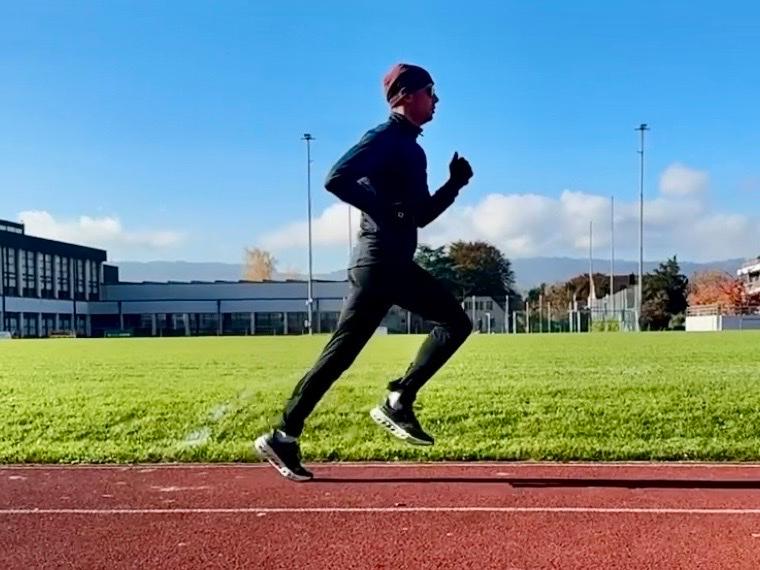
Swing forward and back, with your hands brushing past your hips. On the front swing the hand comes up to about chest height, not higher, and does not cross the middle of your body. On the back swing the elbow goes back behind you. Look at the runner in the photo above: the upright trunk is good, but the front hand is clenched into a fist and raised to chest height, which is the upper limit.
Drill
3 × 30 s
Standing arm swing
Stand tall, elbows at roughly a right angle. Swing your arms loosely forward and back from the shoulders, hands passing your hips, without letting them cross your chest. Keep the shoulders down. Then do the same while marching on the spot.
6. Relaxed hands
Hold your hands loosely, as if you were carrying a raw egg or a crisp you don't want to break. Thumb resting lightly on the index finger. A tight fist sends tension up the forearm into the shoulders and neck.
Posture when you get tired
Almost everyone runs with good posture in the first kilometre. The real test is the end of a long run or race: the hips sink back, the head drops, the shoulders rise and the arms start to cross the body.
Use a short body scan every kilometre or so: tall, look ahead, shoulders down, hands loose, arms forward and back. It takes a few seconds and resets your form before the fatigue settles in.
Strength for a stable trunk
Holding good posture for a long time takes some strength in the trunk, hips and upper back. You don't need a long programme. Two short sessions a week with a few simple exercises help a lot.
Drill
3 × 30 to 45 s, twice a week
Front plank
Forearms and toes on the floor, body in one straight line from head to heels. Breathe calmly and don't let your hips sag or rise.
Drill
3 × 15, twice a week
Band pull-apart
Hold a light resistance band in front of your chest with straight arms. Pull it apart until it touches your chest, shoulders down, then return slowly. No band? Do slow arm circles backwards instead.
How to check your posture and arm swing
Film 10 to 20 seconds of steady running from the side, phone at hip height, 3 to 5 metres away. Pause the video and look: Are head, shoulders and hips in one line? Do your hands cross the middle of your body or rise above chest height? Are your shoulders up near your ears?
Film once fresh and once at the end of a run to see what changes with fatigue. Or upload the clip to Triaform: Tria, Triaform's AI running coach, looks at your stride frame by frame and tells you what you do well, what to fix first and which drill helps.
Questions
Should I lean forward when running?
Slightly, and from the ankles, not the waist. Your body tilts forward as one straight line. If you bend at the hips or feel like you are falling forward, the lean is too much or in the wrong place.
How should your arms move when running?
Forward and back from the shoulders, elbows bent at roughly a right angle, hands passing your hips. They should not cross the middle of your body or rise above chest height.
Why do my shoulders get tense when I run?
Often from fatigue, pushing the pace, or clenched hands. Every kilometre, drop your shoulders, open your hands and loosen your jaw for a moment. If you have pain in the neck or shoulders, have it checked by a physiotherapist.
Does arm swing make you faster?
A good arm swing keeps your upper body quiet and your rhythm steady, so your legs waste less energy. Driving the arms a little more can also help on hills and in a final sprint.
Tria is an AI. This guide is coaching information, not medical advice. If something hurts, see a physiotherapist.
Read next
- Proper running form: the six things a coach checksWhat good running form looks like: foot landing, knee bend, posture, bounce, arm swing and relaxation. The six checks a running coach makes, with drills.Read the guide
- Improve your running form: 8 drillsEight simple running form drills to fix overstriding, posture, arm swing and tension. Exact steps and sets for each, plus a short routine to improve your form.Read the guide