Proper running form: the six things a coach checks

Tria
Your AI running coach
Proper running form means your foot lands close to under your hips, your knee is slightly bent as it lands, you run tall with a slight lean from the ankles, you bounce only a little, your arms swing forward and back, and your shoulders and hands stay relaxed. There is no single perfect running form, because bodies and speeds differ. But these six points are what a good coach looks at first.
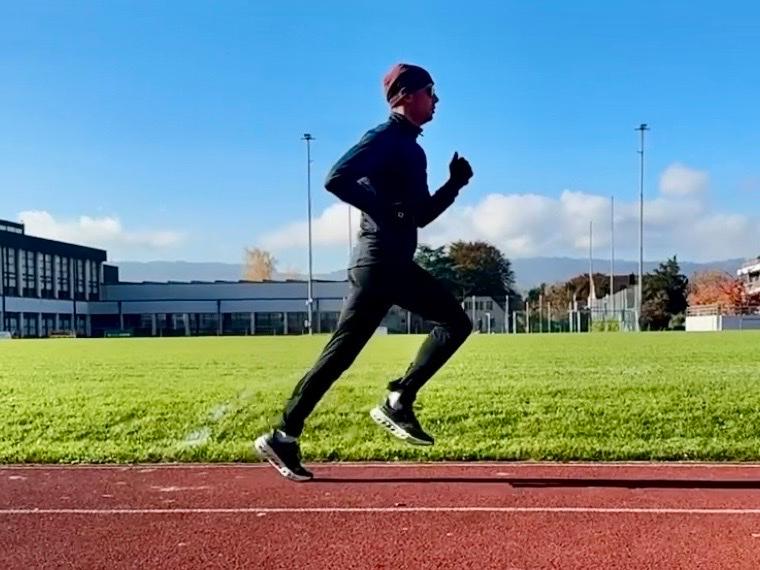
1. Where your foot lands
Watch where your foot touches the ground compared with your hips. When it lands far in front of your body, usually with a straight knee, it acts like a small brake on every step. Coaches call this overstriding.
The goal is not a particular part of the foot. It is landing closer to under you, so your body moves over the foot instead of crashing into it. A slightly shorter, quicker step often fixes this on its own.
Drill
4 × 1 min, twice a week
Quicker, shorter steps
Run at your easy pace. For one minute, take slightly shorter and quicker steps without speeding up, as if the ground were hot. Then run one minute normally and notice the difference.
2. Knee bend at landing
When your foot touches down, your knee should be slightly bent, like a spring that is ready to absorb the landing. A knee that is almost straight passes more of the impact up to the knee and hip.
This usually goes together with point 1: when the foot lands closer under the body, the knee bends by itself.
3. Posture and forward lean
Run tall: head, shoulders and hips stacked in one line, as if a string pulled the top of your head up. The slight forward lean comes from the ankles, not from bending at the waist.
Two common patterns: sitting back with the hips behind you, often when tired, and folding forward at the waist. Both cost energy and make it harder to land under your body.
Drill
5 × 20 m before an easy run
Lean from the ankles
Stand tall with your feet hip-width apart. Keep your body straight like a plank and lean forward from the ankles until you have to take a step. Let that step turn into 20 metres of easy running and keep the tall feeling.
4. How much you bounce
Every running step has some up and down movement. But a lot of bounce means you are pushing yourself up instead of forward, and you land harder each time.
On a side-on video, watch your head against something in the background, like a fence or a line on the wall. If it rises and falls a lot, think “run forward, not up”.
5. Arm swing
Your arms balance your legs. Elbows bent at roughly a right angle, hands swinging forward and back past your hips. They should not cross in front of your chest or come up to your chin.
Arms that swing across the body make the upper body twist, and the legs have to correct for it on every step.
Drill
3 × 30 s
Standing arm swing
Stand tall, elbows at roughly a right angle. Swing your arms loosely forward and back, hands slightly open as if holding a raw egg. Keep the hands below chest height and the shoulders down.
6. Relaxed head, shoulders and hands
Tension travels. A tight jaw, raised shoulders or clenched fists make the whole upper body stiff, and stiffness costs energy, especially late in a race.
A simple routine: every kilometre, drop your shoulders, loosen your jaw and open your hands for a moment. Many runners only notice how tense they were when they let go.
How to check your own running form
You can't see your own form while running, so film it. Ask a friend or put your phone on a steady shelf at hip height, 3 to 5 metres away, and film 10 to 20 seconds of steady running from the side. A treadmill makes this easy.
Then pause the video at the moment your foot touches the ground and go through the six points above. Or upload the clip to Triaform: Tria, our AI running coach, looks at your stride frame by frame and tells you what you do well, what to fix first and which drill helps.
What matters less than you might think
Heel or forefoot: many fast runners land on the heel, and switching to forefoot running on purpose can overload the calves and Achilles tendon. Where the foot lands relative to your body matters more than which part of the foot lands first.
Copying elite runners: their form fits their body, strength and speed. Work on one point at a time, give each change three to four weeks, and film again to compare.
Questions
Is heel striking bad?
Not by itself. Many good runners land on their heel. What matters more is where the foot lands: close to under your hips with a slightly bent knee, rather than far in front of your body with a straight leg.
How long does it take to improve running form?
Usually a few weeks of regular drills before a change feels natural. Work on one thing at a time, do the drills two or three times a week, and film yourself again after three to four weeks.
Can I check my running form without a coach?
Yes. Film 10 to 20 seconds of running from the side and go through the six checks in this guide, or upload the clip to Triaform for an AI coach's read with drills.
Should I change my running form if nothing hurts?
Small changes can make you more efficient, which helps on race day. Make them gradually. If something hurts while running, see a physiotherapist before changing your form.
Tria is an AI. This guide is coaching information, not medical advice. If something hurts, see a physiotherapist.
Read next
- Improve your running form: 8 drillsEight simple running form drills to fix overstriding, posture, arm swing and tension. Exact steps and sets for each, plus a short routine to improve your form.Read the guide
- Running posture and arm swing: run tall and relaxedCorrect running posture and arm swing: run tall, lean from the ankles, keep your shoulders down and swing your arms forward and back. With drills to practise.Read the guide